Tuesday, 17 November 2015

End-time prophecies


How a letter set in motion end-time prophecies concerning Israel


"The LORD your God will restore your fortunes and have compassion on you and gather you again from all the nations where He scattered you."  (Deuteronomy 30:3)

“When they are in the land of their enemies, I will not reject them, nor will I so abhor them as to destroy them, breaking My covenant with them; for I am the LORD their God.”  (Leviticus 26:44) November 2, was an important anniversary of an event that began the process of the fulfillment of Bible prophecy concerning Israel in these last days. It was the anniversary of a letter issued by the British government favoring the establishment of a national home for the Jewish People. The consequences of that letter, the Balfour Declaration of 1917, still reverberate around the world 98 years later. "Today we remember and welcome those people among the nations of the world who have not forgotten history and who remember our link to our land and our right to [a] state of our own," Israeli Prime Minister Benjamin Netanyahu said on the anniversary of the Balfour Declaration last year.
 
Jerusalem

According to And the Hills Shouted for Joy; the Day Israel Was Born, "The Balfour Declaration was the first public acknowledgment by a Great Power of the Jewish connection with Palestine as well as an undertaking by that government to help restore the Jewish people to its homeland.   For the first time a sovereign government had entered into a pact with a people scattered over the face of the earth to return them to a land." The Balfour Declaration — the fruit of 12 months of intensive negotiations between Foreign Office officials, Prime Minister David Lloyd George, and leading British Zionists — was issued by Arthur James Balfour, the British Foreign Secretary, to Lord Walter Rothschild, a British Jewish leader who was to convey the news to the Zionist Federation of Great Britain and Ireland.
 
 
The first High Commissioner Herbert Samuel (left) in the governor's
house in Jerusalem stands with Lord Arthur Balfour (middle) and
General Edmond Allenby (right), who captured Jerusalem from the
Ottoman Empire.

Here is the complete text:

Foreign Office,
November 2nd, 1917.

Dear Lord Rothschild,

I have much pleasure in conveying to you, on behalf of His Majesty's Government, the following declaration of sympathy with Jewish Zionist aspirations which has been submitted to, and approved by, the Cabinet. “His Majesty's Government view with favour the establishment in Palestine of a national home for the Jewish people, and will use their best endeavours to facilitate the achievement of this object, it being clearly understood that nothing shall be done which may prejudice the civil and religious rights of existing non-Jewish communities in Palestine, or the rights and political status enjoyed by Jews in any other country”. I should be grateful if you would bring this declaration to the knowledge of the Zionist Federation.

Yours sincerely,

Arthur James Balfour 


Lord Rothschild was an active Zionist who worked
to formulate the draft declaration for a Jewish
homeland in Palestine.

Bible Prophecy Fulfilled

The Balfour Declaration was incorporated into the Treaty of Sevres peace agreement with the Ottoman Empire and the League of Nations Mandate for Palestine, which gave international sanction for the establishment of a national Jewish homeland and, therefore, became the legal cornerstone for the Jewish State. The door opened by the Balfour Declaration helped fulfill Bible prophecy that foresaw God would “gather together the dispersed of Judah from the four corners of the earth.”  (Isaiah 11:12) God was moving through a world power to fulfil countless Bible prophecies concerning Israel, as well as His covenant promises to return His people to their land. Apparently Lord Balfour was aware of God’s plan for Israel.  According to the Jewish Chronicle, “The Balfour Declaration was born out of religious sentiment.  Arthur Balfour was a Christian mystic who believed that the Almighty had chosen him to be an instrument of the Divine Will, the purpose of which was to restore the Jews to their ancient homeland—perhaps as a precursor to the Second Coming of the Messiah. “The Declaration was thus intended to assist in the fulfillment of biblical prophecy.  This appealed to Lloyd George, whose private immorality did not prevent him from believing in the prophecies of a Bible he knew inside out.”
 
 
Arthur Balfour

Bringing His People Home

“I will scatter you among the nations and will draw out My sword and pursue you.  Your land will be laid waste, and your cities will lie in ruins.”  (Leviticus 26:33)

We read in the Torah (Five Books of Moses) that God set before the Israelites blessings and curses.  The blessings would flow from obedience to God’s laws.  The curses would flow from disobedience to His laws. Part of the curse called for exile from the Promised Land, but God nevertheless promised that He would eventually bring His people home. Israel’s disobedience did not take God by surprise.  From the beginning, the Lord knew that the people whom He had chosen were stiff-necked and that they would eventually be driven from the land that He had given to Abraham’s seed as an inheritance. The makings of the first dispersion began with the reign of King Solomon, about 980 BC, when the kingdom of Israel split. The 10 northern tribes rebelled against King Rehoboam, who was a cruel and godless son of Solomon, the son of David, of the tribe of Judah.
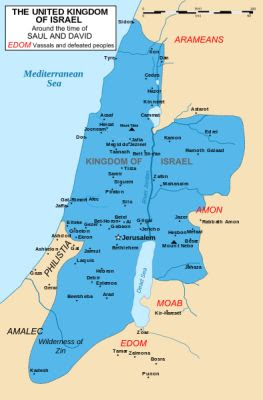
  
The United Kingdom of Israel

After King Solomon died in 931 BC, his son King Rehoboam told all of Israel that rather than making their burden lighter than what it had been under his father Solomon, he would make it heavier. “My father made your yoke heavy, and I will add to your yoke: my father also chastised you with whips, but I will chastise you with scorpions,” Rehoboam said.  (2 Chronicles 10:11) This caused the 10 tribes who lived north of Judah and Benjamin to rebel, cutting themselves off from the tribes of Judah and Benjamin.  Even so, 1 Kings 12:15 states this was God’s will: “This turn of events was the will of the LORD, for it fulfilled the LORD's message to Jeroboam son of Nebat through the prophet Ahijah from Shiloh." This refers to a prophecy near the end of Solomon’s reign, when the prophet Ahijah told Jeroboam, a man who worked for Solomon: “Behold, I will rend the kingdom out of the hand of Solomon, and will give ten tribes to you.”  (1 Kings 11:31) As the king of the northern tribes, however, Jeroboam worried that he would lose control over those people who went up to Jerusalem to worship. To distance the people from worship at the Holy Temple, he set up false gods in local towns to be worshiped by the northern tribes.  This resulted in further moral deterioration. “‘If this people go up to offer sacrifices in the house of the LORD at Jerusalem, then the heart of this people will return to their lord, even to Rehoboam king of Judah; and they will kill me and return to Rehoboam king of Judah.’  So the king consulted, and made two golden calves, and he said to them, ‘It is too much for you to go up to Jerusalem; behold your gods, O Israel, that brought you up from the land of Egypt.’  He set one in Bethel, and the other he put in Dan.” (1 Kings 12:26–29)
The Northern Kingdom of Israel and the Southern Kingdom
of Judah.

The Fall of Israel

By about 712 BC, the immorality and pagan worship of the northern tribes brought about the collapse of the Northern Kingdom of Israel.  The Assyrians invaded and took the ten tribes captive.  (2 Kings 17:6) The Assyrians scattered them throughout the Levant, which brought about the beginning of the Diaspora (dispersion). Why didn’t the Assyrians also invade the Southern Kingdom of Judah?  The obvious answer is that it was not God’s will for them to do so.  The king of Judah at that time, Hezekiah, “did that which was right in the sight of the Lord."  (2 Kings 18:3) Nevertheless, rebellion against God through the next generation led to the Babylonian invasion of the Southern Kingdom around 606 BC, taking Judah captive to Babylonia. Seventy years later, in fulfilment of Bible prophecy, the Babylonian kingdom fell to the Medes and Persians and the Jews were permitted to return to Jerusalem, at which time the walls and the Temple were rebuilt. “This is what the LORD says: ‘When seventy years are completed for Babylon, I will come to you and fulfil my good promise to bring you back to this place.  For I know the plans I have for you,’ declares the LORD, ‘plans to prosper you and not to harm you, plans to give you hope and a future.’”  (Jeremiah 29:10–11) Though God made a way for them to return home, many Jewish People were assimilated into the land of their captivity and chose not return to the Promised Land.  Sadly, some who did choose to return to Israel, brought with them the foreign worship practices that they adopted as their own, sowing the seed for future rebellion and exile.
  
Hanukkah, which celebrates the restoration of Jewish worship under the
valiant leadership of Judah Maccabee and the miracle of the Temple
menorah remaining lit for eight days with a one-day supply of oil, is still
celebrated today.

By 200 BC, Israel had become a part of the Greek Seleucid Empire until the revolt of Judah Maccabee resulted in the Hasmonean dynasty of kings who ruled Judah for over a century. The Maccabees destroyed pagan altars that had been set up in the villages, and reinstated circumcision of newborn male offspring which had been outlawed by the Greek Hellenistic government.  They also re-entered Jerusalem and ritually cleansed the Temple, re-establishing traditional Jewish worship. Judah Maccabee, the Cohen (priest) who led the revolt against the Greek Empire, made an alliance with Rome, instead of trusting in God alone.  (1 Maccabees 8:17–32) Despite this alliance, the Greek Empire sent in massive military forces.  Judah decided to stand his ground instead of withdrawing and died in the battle.
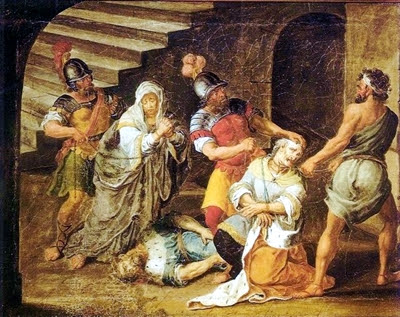
The Death of Judah Maccabee

So for a brief period of about one hundred years, devout observance of the law returned to Judah under the Hasmonean Kingdom. When the matriarch of the Maccabees died, the two sons rivaled for power over the kingdom.  Even during their feud, though, they agreed to keep up the sacrifices of sheep and goats at the Temple — until one day one of the sons sent a pig to the altar. The Talmud states that when the pig swiped his hooves against the Temple, Israel shook for 400 miles. Not long after, the Roman invasion of Jerusalem in the first century BC brought this period of religious and civil independence to a close.
In order to perpetuate his name for eternity, King Herod undertook a
massive renovation and reconstruction of the Second Temple.

Under Rome, Herod the Great ruled Judea until his death in 1 BC.  Following his death, his kingdom was divided among his three sons as a tetrarchy. This was the political situation in Judea at the time when Yeshua (Jesus) was born. Yeshua prophesied regarding the impending destruction of the Temple and the scattering of God’s people.  (Luke 21:5–6) He also warned his Talmidim (disciples) of events that would occur within their lifetime, as well as in the last days.  (Matthew 24:15–22) In fulfilment of His prophecies, after His death and resurrection, Jerusalem was destroyed by the Romans in AD 70 during the Jewish Revolt, further scattering the people throughout the world and into distant lands. Seventy years later, the Jews again revolted under the leadership of Simon bar Kokhba and established the last Kingdom of Israel, which lasted three years. The final destruction came when the Roman Emperor Hadrian, who was determined to wipe out the identity of Israel, completely destroyed the Jewish city of Jerusalem, plowing it under and building a city called Aelia Capitolina on top of it. In AD 135, Hadrian changed the name of Israel to Syria Palaestina, essentially in honour of Israel's enemies, the Philistines.
 
 
The Prophecy of the Destruction of the Temple

Zionism Emerges

"For I will give the command, and I will shake the people of Israel among all the nations as grain is shaken in a sieve, and not a pebble will reach the ground.”  (Amos 9:9) In 1800, only 6,700 Jews lived in what was then Ottoman Palestine.  Although the Jewish People were spread virtually everywhere on the planet, God had not forgotten His people, nor had He forsaken His promises and covenant with them. By the 19th century, it was evident that God was actively at work among His people, drawing them to Himself.  And it was evident that end-time Bible prophecies concerning the land of Israel were in the process of being fulfilled. By 1880, the emerging Zionist movement worked to return the Jewish People to the Land; at that time, about 24,000 lived there.  By 1918, that number had almost tripled, reaching 60,000.

Theodore Herzl is considered the father of
modern Zionism.

The term Zionism is derived from the word Zion (ציון—Tzi-yon), which refers to Mount Zion — originally Mount Moriah, where Abraham brought Isaac.  It was here that King Solomon built the first Temple. Generally, Zion now refers to all of Jerusalem and even Israel.  Today, anyone who supports the right of the state of Israel to exist and the return of the Jewish People to Israel is a Zionist. God is a Zionist too: “So you shall know that I am the Lord your God, who dwells in Zion, My holy mountain.”  (Joel 3:17) A major leader behind the Zionist efforts was Theodore Herzl, the Austrian journalist who had worked to restore the Jewish People to their land.  He created the World Zionist Organization (WZO) and held its first congress at Basel, Switzerland in 1897. In 1917, during WWI, the British replaced the Ottoman administration of Palestine and occupied the region including Jerusalem allowing for the Balfour Declaration to have political leverage. 

British General Edmund Allenby, who captured Jerusalem from the
Ottoman Empire, reviews an honor guard of British soldiers in
Jerusalem's Old City.

The Balfour Declaration

“Then it will happen on that day that the Lord will again recover the second time with His hand the remnant of His people, who will remain….   And He will lift up a standard for the nations and assemble the banished ones of Israel, and will gather the dispersed of Judah from the four corners of the earth.”  (Isaiah 11:11–12) With the British in Palestine, the hopes and aspirations of the Zionist cause to return the Jewish People to their land reached a new height. During the First World War, the Russian chemist Chaim Weizmann (who would become the first president of the Jewish state) invented a process to produce the explosive cordite without the use of calcium acetate, an ingredient available in Germany, but not in England. Without cordite the British would have lost the war. When Lord Balfour, the British Foreign Secretary, asked Weizmann what payment he required for the process, Weizmann responded, “There is only one thing I want: a national home for my people.” Before WWI, in 1906, the British offered Kenya (some say Uganda) to Zionists as a Jewish homeland.  The Zionists rejected this.

 
President Chaim Weizmann was a science
professor before becoming Israel's first president.

When Balfour asked Dr. Weizmann why only Palestine could be the Jewish homeland Weizmann said, “Anything else would be idolatry,” adding, “Mr. Balfour, supposing I were to offer you Paris instead of London, would you take it?” “But Dr. Weizmann,” said Balfour, “we have London.”  Weizmann responded, “That is true, but we had Jerusalem when London was a marsh.” Some say that Weizmann was rewarded for his service on November 2nd, 1917 when the Balfour Declaration was handed to Rothschild. Although God used this declaration to set in motion a series of events upon which the Jewish state was reborn in one day (Isaiah 66:8), it was not without challenges. As God began drawing larger numbers of the Jewish People to their homeland, much treachery erupted. The British did not hold fast to their promises to help establish and protect the new nation, and the British Mandate for Palestine continued, causing the Jewish People to once again struggle for their very survival as they held their own against British and Islamic intrigue.

 
Israeli children

While some governments do renege on their promises, God does not. Though things may look bleak for Israel 98 years later, as Palestinians murder Jews in Jerusalem and riot on the Temple Mount, and as anti-Semitism continues to rear its ugly head around the globe, we know that with God, Israel has a hope and a future. God has miraculously re-established the Jewish state and the Hebrew language — something that has never happened for any other country or people. As we thank God for the Balfour Declaration, we can also thank Him that He is true to His Word. Even if we cannot see the end from the beginning, we can be sure that God always keeps His promises to all Believers and to Israel. Israel is and will be a nation and a people forever. “’I will bring My people Israel back from exile.  They will rebuild the ruined cities and live in them.  They will plant vineyards and drink their wine; they will make gardens and eat their fruit.  I will plant Israel in their own land, never again to be uprooted from the land I have given them,’ says the LORD your God.”  (Amos 9:14–15)


“In those days and at that time, when I restore the fortunes of Judah and Jerusalem, I will gather all nations and bring them down to the Valley of Jehoshaphat.  There I will enter into judgment against them concerning My inheritance, My people Israel, for they scattered my people among the nations and divided up My land.”  (Joel 3:2) The Balfour Declaration played a role in the prophetic fulfilment of Israel’s rebirth as a nation in May 1948. While this important anniversary reminds us that God's hand is on Israel, the Bible links the creation of the State of Israel to the end times when the nations will come up against Israel and be judged in the Valley of Jehoshaphat. Since we are living in the Last Days with Yeshua's (Jesus) return not far away, let us be diligent to redeem the time.

Monday, 16 November 2015

Israel News


 Palestinians Blame Israel for Paris Attack Due to EU Product Labeling of Settlement Products


Israeli Prime Minister Benjamin Netanyahu and American President Barack
Obama meet at the White House on November 9, 2015.

Netanyahu and Obama Strengthen Ties at the White House

“Unless the Lord builds the house, the builders labor in vain.  Unless the Lord watches over the city, the guards stand watch in vain.”  (Psalm 127:1)

On Monday, Israeli Prime Minister Benjamin Netanyahu met with United States President Barack Obama at the White House — the first meeting between the two in a very eventful year. For two and a half hours, Netanyahu and Obama discussed (in the words of Obama), “some of the most pressing security issues that both our countries face,” including “how we can blunt the activities of ISIL, Hezbollah [and] other organizations in the region that carry out terrorist attacks.” Despite the strain created by Netanyahu’s opposition to the Iran nuclear deal, the meeting went well with Netanyahu calling it “one of the best meetings I’ve had with him [Obama].”
Israeli Prime Minister Benjamin Netanyahu and his
wife Sara embark for Washington D.C.

The leaders sought to weigh Iran’s implementation of the nuclear agreement with Iran’s destabilizing activities in the Middle East, address the chaos in Syria, and lower tensions between the Israelis and Palestinian Authority. Those tensions have sharply risen since the Jewish New Year, after which Palestinian and Israeli Arabs have been committing multiple attacks against other Israelis and Jews. “I don’t think that anyone should doubt Israel’s determination to defend itself against terror and destruction; but neither should anyone doubt Israel’s willingness to make peace with any of its neighbours that genuinely want to achieve peace with it,” Netanyahu said. In reference to the Islamic State’s savagery and Iranian aggression and terror, Netanyahu stated, “The combination of turbulence has now displaced millions of people, has butchered hundreds of thousands, and we don’t know what will transpire.”
 
President Obama and PM Netanyahu shake hands
at the White House. 


“I think this is a tremendously important opportunity for us to work together to see how we can defend ourselves against this aggression, this terror, how we can roll it back; it’s a daunting task,” Netanyahu added “Equally I want to make it clear that we have not given up our hope for peace; we’ll never give up our hope for peace,” he said.  “And I remain committed to a vision of peace of two states for two peoples, a demilitarized Palestinian state that recognizes the Jewish state.” The president described Netanyahu’s visit as “an opportunity to discuss some of the concerns that both of us have about the violence in the Palestinian territories,” seemingly ascribing Palestinian status to Judea and Samaria.  Yet he did not ask Netanyahu to freeze settlement building, the prime minister said the next day. To the press, Obama said, “I want to be very clear that we condemn in the strongest terms Palestinian violence against innocent Israeli citizens, and I want to repeat once again it is my strong belief that Israel has not just the right but the obligation to protect itself.” For the US, “the military assistance that we provide, we consider not only an important part of our obligation to the security of the State of Israel, but also an important part of US security infrastructure in the region, as we make sure that one of our closest allies can not only protect itself but can also work with us in deterring terrorism and other security threats,” Obama had said minutes before, naming Israel’s security as one of his top foreign-policy priorities. The two leaders also discussed updating the Memorandum of Understanding signed in 1981, which outlines strategic cooperation policies and procedures between the US and Israel regarding the Soviet threat in the region.  The agreement is currently slated to expire in 2017. “We’re with each other in more ways than one, and I want to thank you for this opportunity to strengthen our friendship [and] our alliance,” Netanyahu said to Obama.  “I think it’s rooted in shared values; it’s buttressed by shared interests; it’s driven forward by a sense of a shared destiny.”
Prime Minister Benjamin Netanyahu addresses the General Assembly
of the Jewish Federation.
Netanyahu to Jewish Americans: Unity Is Paramount

"'At that time,' declares the LORD, 'I will be the God of all the families of Israel, and they will be My people.'"  (Jeremiah 31:1)

On Tuesday, 3,000 attended a meeting of the General Assembly of the Jewish Federations of North America where Israeli Prime Minister Benjamin Netanyahu emphasized the need for unity among the Jewish People around the world. "No matter what disagreements there have been within the Jewish community, maintaining the unity of our people is of paramount importance," Netanyahu said. "Whether Jews decide to live in Israel or not, I want to guarantee one thing to each and every one of you:  As Prime Minister of Israel, I will always ensure that all Jews can feel at home in Israel — Reform Jews, Conservative Jews, and Orthodox Jews— all Jews," he added. Netanyahu announced the establishment of a round table to address the concerns of the different streams of Judaism in Israel. "That's significant.  That's a governmental decision," he said.  "And now, for the first time, the Government of Israel is joining with the Jewish Agency to invest in strengthening Reform and Conservative communities within Israel.  I am also hopeful that we will soon conclude a long overdue understanding that will ensure that the Kotel [Western Wall] is a source of unity for our people, not a point of division." "There is only one Jewish people.  There is only one Jewish state.  And now, more than ever, we must work together to unite the Jewish people and secure the Jewish state," he said. Netanyahu reported to the Jewish Federations' General Assembly that Obama had promised "to maintain Israel's qualitative military edge so that Israel can ‘defend itself, by itself,’ against any threat." "Obama's commitment to bolster Israel's security for the next 10 years" comes in return for Israel's "assistance almost on a daily basis, in intelligence and many other things," Netanyahu said.
 
Prime Minister Benjamin Netanyahu and his wife Sara listen to a speaker
at the Jewish Federations of North America General Assembly.

Ethiopian Aliyah Promises Final 9,000 Immigrants

"He who scattered Israel will gather them and will watch over His flock like a shepherd."  (Jeremiah 31:10)

In fulfillment of Bible prophecy, God continues to draw His people home to the Holy Land.  The Jewish state's 125,000 Ethiopian Israelis will grow by another 9,146 if Ethiopia's Jewish-descendant community receives approval for aliyah (immigration) from the Israeli Cabinet. A draft proposal submitted by Israel's Interior Minister Silvan Shalom this past week seeks to secure citizenship for an updated list of Ethiopians waiting in the Ethiopian cities of Gondar and Addis Ababa for aliyah to Israel. The so-called Falash Mura, a somewhat pejorative term meaning converted falasha (foreigners/exiles), are Ethiopians who have Jewish ancestry but who converted in the 19th and 20th centuries in the face of persecution and economic discrimination. Some adopted Christian beliefs without abandoning Judaism; others never practiced Judaism, and due to this, "the Israelis saw them as non-Jews," writes Jewish Virtual Library. Beta Israel (the Ethiopian Jewish community) also did not recognize the Falash Mura as part of their community.  Still, many are inarguably relatives of Beta Israel families.
 
Ethiopian women at the Kotel (Western Wall) in Jerusalem during
Chol HaMoed (the week of) Passover.

The first wave of 8,000 Ethiopian olim (immigrants) came over a seven-week period from November 1984 to January 1985 during the clandestine Operation Moses.  Many Falash Mura came to Israel with Beta Israel in 1991 during Operation Solomon, when Israel covertly transported over 14,000 Ethiopian Jews to Israel in 36 hours. The last immigration wave came through Operation Dove's Wings, which brought another 7,000 or so "eligible" Falash Mura to Israel in August 2013.  (Jewish Agency) As a result of these operations, many families were separated. "While some members of their families came to Israel, after having met the conditions of the various cabinet decisions regarding the Falashmura," the proposal states, these descendants of Jews were not recognized as Jews.  They had, therefore, "remained in Addis Ababa and Gondar, living a Jewish life, with active synagogues, ritual baths, Sabbath and holiday observance, study of Hebrew and Judaism, etc." Those who didn't qualify for aliyah in 2013 remained in Addis Ababa and Gondar even though they had already left their villages, homes, land and cattle behind.  Everything they owned was forfeited and claimed by others.
 
An Ethiopian Falash Mura woman and her baby, part of a group of 81
new olim who are being transported by bus after arriving at Ben Gurion
Airport.
 

The Jewish Agency operation left questions "about the fate of those left behind and whether the government's determinations on who was eligible to make aliyah were valid," wrote Michal Shmulovich for the Times of Israel in August 2013. The two criteria to receive an entry permit to Israel in 2013 were that the olim be "descended from Ethiopian Jews on their mothers' side, and that they appear on one of the lists attached to the government decisions in question," Shalom's proposal states. However, "some in Gondar say they were given a false sense of hope, stemming from a confusing selection process amid shifting government criteria, only to find out, years later, that they weren’t eligible for aliyah," Shmulovich said. Objectors to the immigration of the group said that the Beta Israel community already had enough trouble preserving their Jewish faith and don't need an influx of members who are weak in the Jewish faith or don't practice it at all. Shalom's proposal helps to remedy this concern by requiring applicants who have been waiting in these two Ethiopian cities since before January 1, 2013, to state their intention to convert in Israel — to be recognized formally as Jews. The proposal comes after a lengthy public campaign that was started in late 2010 by Ethiopian Israelis, volunteer groups, and members of the Knesset.
 
Ethiopian Falash Mura immigrants disembark after arriving at Ben Gurion
Airport in January 2009.  
(Photo by Brian Hendler)

Shalom's proposal to restore the Ethiopian families of Israel might link to Prime Minister Benjamin Netanyahu's speech before the Jewish Federation of North America this past week when he said, "I will always ensure that all Jews can feel at home in Israel — Reform Jews, Conservative Jews, Orthodox Jews — all Jews." Optimistically, perhaps, Israel's intentions toward a deeper recognition of the various streams of Judaism would include recognition of Jews by paternal descent and more varied expressions of the Jewish faith. Meanwhile, Shalom's proposal describes itself as "the last state-organized aliyah of Ethiopians to Israel" and the last hope perhaps for the Falash Mura to reach Israel.
 
An Ethiopian woman prays toward the Temple Mount.

Palestinians Say Israel Perpetuated Paris Attack as Retaliation for EU Labeling of Settlement Products

"But I am like an olive tree flourishing in the house of God; I trust in God’s unfailing love for ever and ever.  For what You have done I will always praise You in the presence of your faithful people."  (Psalm 52:8–9) On Wednesday, in a move that is tantamount to a boycott of Israeli products and a punishment of Israel for the absence of a renewed peace process, the European Parliament adopted a resolution to label as "settlement products" goods produced by Israelis or Jews across the pre-1967 lines. A large majority of the Parliament voted to support the Interpretative Notice resolution which, when implemented, will distinguish between products made in "pre-1967 Israel" and products made by Israelis in "post-1967 Israel" — the Golan Heights, Judea, Samaria, and eastern Jerusalem. The European Union (EU) insists the move is a compliance measure to provide correct information about point of origin and not a boycott of Israel. US State Department spokesman Edgar Vasquez backed that sentiment saying, "We do not believe that labeling the origin of products is equivalent to a boycott.  And as you know, we do not consider settlements to be part of Israel.  We do not view labeling the origin of products being from the settlements as a boycott of Israel.”
 
Lychees grown in Israel

Thirty-six US senators responded to EU Foreign Policy Chief Federica Mogherini, who led the product labeling efforts saying, "We believe strongly that these efforts are unwarranted, dangerous and damaging to the prospects of a negotiated solution to this conflict." Indeed, the labeling will be damaging to peace efforts between the Israelis and the Palestinian Authority. The Palestine Liberation Organization (PLO) commented on the EU decision as a "step in the right direction but insufficient," pushing that "products of a war crime must be banned, not just labeled." Palestinian media, Fatah, and the Palestinian Authority also exploited the recent terror attacks on France to imply or outright state a that Israel orchestrated the attacks because they were unhappy with the EU decision.It is not a coincidence that human blood was exploded in Paris at the same time that certain European sanctions are beginning to be implemented against settlement products, and while France leads Europe in advising the security council that will implement the two-state solution, Palestine and Israel — which the Israelis see as a warning of sudden danger coming from the direction of Europe, where the Zionist, occupying, settling endeavor was born.. The wise and correct thing is to look for who benefits.  In short: They need to search the last place reached by the octopus arms of the Mossad...  It is clear that its ‘Mossad’ will burn Beirut and Paris in order to achieve [Israeli Prime Minister Benjamin] Netanyahu’s goals.  He, who challenged the master of the White House, hides in his soul enough evil to burn the world.”  (PalWatch translation of Al-Hayat Al-Jadida, Nov. 15, 2015) To further demonize Israel, Fatah falsely claimed on its Facebook page that Israel is perpetrating the same acts of terror that occurred in Paris against Palestinians — not only that but the post stated that the Jewish state is responsible for violence around the world. “As a people who suffer daily aggressions by Israel we understand the suffering of the injured and the families of those who were killed in a cold blood.  Palestinians know the bitter taste of losing beloved ones as the Israeli army is killing civilians in Palestine almost by the hour...  We in the Fatah movement look forward to see the entire world winning this battle against terror especially in the Middle East.  We know that restoring peace and stability in the Middle East is the first step to dry the sources of terrorism throughout the world.  It is time to end the brutal Israeli occupation which breeds violence in the entire world.”
 
PM Netanyahu meets with the United States Senate leadership.

Prime Minister Benjamin Netanyahu said the European Union should be "ashamed of itself,” saying product labeling is hypocritical. For instance, the EU does not label goods from northern Cyprus, which Turkey took control of in 1974, and merely describes it as "an internal issue." International legal expert professor Eugene Kontorovich of Northwestern University School of Law agrees that the move is hypocritical. "It is entirely inconsistent with EU policies towards other areas where they do not recognize a country's sovereignty. …  For example, in Western Sahara, the EU does not recognize Moroccan sovereignty but insists it is OK to label goods from there 'Made in Morocco," he said. "It creates an atmosphere of delegitimization, and paves the way for further and more severe restrictions, which are surely coming if these measures are not defeated.  The goal is to create a legal ghetto for Israel," he said, urging Israel to fight the decision in court while it can.  "But if Israel just decides that [this labeling issue] is only about settlements, only about a small amount of trade, and not worth fighting for, it will soon face far more serious restrictions."
GPO graphic

Israeli leaders rejected product labeling as "grave," "damaging," and "a shameful step giving a prize to terrorism and the people behind it." The State of Israel is considering legal action through the World Trade Organization, whose treaties establish the European action as illegal. Netanyahu rejects the labeling saying it is a means to target "the side that is being attacked by terrorism." Tzipi Hotovely, Israel's deputy foreign minister, told the EU via Israel's Channel 2 TV:  "We say you can't be involved in what is going on in the Middle East while you are taking such an extreme step of labeling products … boycotting us." The Foreign Ministry also issued a statement condemning the EU's decision, adding, "We regret that the EU chose for political reasons to take an unusual and discriminatory step which is drawn from the realm of boycotts, just as Israel is facing a wave of terror directed at all citizens." Senior commentator Dan Margalit in an opinion piece for Israel HaYom calls the labeling efforts "the 2015 version of the yellow Star of David" and "blatantly anti-Israel."


Israel Boosts India's Crop, Milk, Floral Production

"If you pay attention to these laws and are careful to follow them, then the Lord your God will keep His covenant of love with you, as He swore to your ancestors. … He will bless the fruit of your womb, the crops of your land — your grain, new wine and olive oil — the calves of your herds and the lambs of your flocks in the land He swore to your ancestors to give you."  (Deuteronomy 7:12–13) Israel's largest agricultural project abroad, the Indo-Israel Agriculture Project (IIAP), continues to boost quality and productivity of India’s farmers. "Israel is a leading authority and pioneer in irrigation, purifying and water recycling techniques for agriculture, due to its vast regions of arid and semi-arid land," writes Fresh Fruit Portal. As well, it is a leader in agritech innovations that have been boosting agriculture quality and production in many nations, including India.
The Head of MASHAV Ambassador Gil Haskel; Israel's Minister of
Agriculture Yair Shamir; India’s Minister of Food Processing Industries
Harsimrat Kaur Bada; and Israel's Ambassador to India Daniel Carmon
hold fresh produce grown on one of the Indo-Israel MASHAV Centres
of Excellence.

Israel is sharing its innovation and expertise in greenhouse, irrigation and fertigation methods via workshops to 25,000 farmers a year in ten Indo-Israel Centres of Excellence (CoE) in nine states of India. Thirty centres across India are in various stages of development thanks to a partnership that began in 2008 by MASHAV, Israel's Agency for International Development Cooperation and India's Mission for Integrated Development of Horticulture as well as state governments and the Israeli embassy in India. Training centres are dedicated to "growing vegetables, flowers, citrus, mango, pomegranates, dates, [and performing] beekeeping and dairy husbandry," the MASHAV website states.  "Over the last four years, since the Karnal centre was set up, over 2,500 farmers from Punjab and Haryana have started using greenhouse farming for higher yield and newer varieties."
 
The Indo-Israel Centre of Excellence for Mango

At the centres for vegetables and fruits, farmers can purchase and plant seeds for a nominal fee.  When the seedlings are ready, the farmers transplant them in their own fields. "[It] is not possible for a single farmer to get the infrastructure that this centre has. ...  Huge numbers [of seedlings] we wanted; it would be more risky if we grow the seedlings ourselves.  So that's how we approached the centre," said Ramandeep Singh Sandhu, a farmer who utilizes the CoE at Punjab. Farmers are now growing about 6 million vegetable seedlings annually. This is a significant increase since the first centre opened in 2011 when area farmers were only growing about half a million seedlings.  Moreover, to increase diversity and profits, farmers are learning to grow different kinds of vegetables, such as chili, tomato, capsicum, cabbage, and broccoli. Indian farmers are also learning about water-use improvements, including optimized water management, water quality and micro-irrigation, and the soil-water-plant relationship. "We will set up the remaining centres in the third phase of the project 2015–18.  We will also focus on modern dairy management, post harvesting and sewage water treatment for reuse in agriculture," said Dan Allof, Counselor at MASHAV.
 
Indo-Israel Centre of Excellence for Fruits (Citrus)

Meanwhile, in January, Indian Prime Minister Narendra Modi appealed to Israel to help introduce a "white revolution" in India — an increase in milk production. In the birthplace of Hinduism where the cow is deified, the per capita output of milk is the lowest in the world, according to Algemeiner.  In Israel, on the other hand, dairy cows are the most productive in the world; they produce 10 percent more than cows in the United States and 50 percent more than those in Germany. Soon after, on April 15, MASHAV signed a Memorandum of Understanding with India on setting up a Centre of Excellence in India's dairy sector in the state of Haryana where two other CoEs are located.  (Deccan Herald) In the Memorandum, MASHAV committed to helping Haryana build "customized modern dairy sheds for 110 cows (with a potential of expanding it to 300 cows), calves barns, heifer sheds, a feed centre, a milking parlor, mini dairy plant, class room, a visitors' gallery and a waste-water treatment facility." Last year, the trade officer for Indo-Israel trade facilitation at the Embassy of Israel in New Delhi, Akhil Choudhary said with Israel's effect on India's production, "we are talking about a three-fold increase in milk production with the same cattle population with better, hygienic and cost-effective processing facilities."
 
Women prepare to transport their seedlings to their farm.

Beyond introducing cooling systems, biometrics and milk meters to India, MASHAV also has committed to orchestrate the transfer of viable cow embryos and frozen seed to introduce Israeli stock into India's cattle population. In April of this year, Israel also established the first Centre of Excellence for Cut Flowers, located in India's number-one flower-producing state, Tamil Nadu. Tamil Nadu already provides a quarter of India's flower production; through the flower centre, Israel will "provide training, technology and expertise" to increase the productivity and impact of the state's flower farmer.