Thursday, 5 February 2015


Repairing the World on Tu B'Shvat - 1   

       
Spring blossoms
Shana Tova (Happy New Year)
“He will be like a tree planted near water.”  (Jeremiah 17:8)
Today, Wed, Feb 4, 2015 in Israel and around the world celebrating Tu B’Shvat (the 15th of the Hebrew month of Shvat)—the Jewish holiday that recognizes a time of renewal and the stirrings of a new season by celebrating the New Year for Trees. While this holiday is not mentioned in the Bible, it is associated with the Biblical tithe of produce.
 Harvesting olives at Nazareth Village, a
re-creation of life during the time of Messiah.

Hillel, Yeshua, and the New Year of Trees

“I am like an olive tree flourishing in the house of God; I trust in God's unfailing love for ever and ever.”  (Psalm 52:8)

The oldest reference to this holiday is found in the Talmud (first and second century book of rabbinic decisions), where it is called Rosh HaShanah La’Ilanot (New Year of the Trees). The rabbis placed special emphasis on trees. For example, the Me’Am Loez (an 18th and 19th century Bible commentator) writes: “Man’s life is dependent on trees, and the tree is so important for the existence of the world that the sages established a special blessing for those who go out in [the Hebrew month of] Nisan and see blossoming fruit-producing trees.  [The blessing says] ‘nothing is lacking from His world and He created good creations and good trees for the benefit of man.’” Traditionally the holiday is referred to as Hamisha Asar B’Shvat, which means Fifteenth of Shvat.  In modern Israel, it became Tu B’Shvat.
 A child selects fruit at an outdoor market in Tel Aviv.

If the idea of a New Year of Trees sounds strange, the Mishnah (rabbinic discussions that make up the Talmud) list four separate new years in Judaism.
  1. The first of the month of Nisan (usually coincides with April), which is the new year for counting the reign of kings and for ordering holidays;
  2. The first of Elul, which is considered as being the new year for animal tithes;
  3. The first of Tishrei (usually coincides with September), which is used as the new year for calculating Jubilee and Sabbatical years; and
  4. The fifteenth of Shvat, which is the beginning of the agricultural year for planting and sowing, according to Hillel, a first century sage who dominates mishnaic rabbinic thought.  (Rosh Hashana:2a)
Hillel headed one of two main houses of Pharisaic practice, lived in Jerusalem, and died in AD 10.  While he might have died a couple of years before 12-year-old Yeshua (Jesus) stayed behind at the Temple to discuss questions of the Law, certainly some of Hillel’s talmidim (disciples) were present. The Talmud sages supported Hillel, making the 15th of the Hebrew month of Shvat the date for determining the beginning of the agricultural cycle for the purpose of Biblical tithes. 


Yeshua Among the Doctors, by James Tissot
  
Biblical Tithing of Fruit

“When you enter the land and plant any kind of fruit tree, regard its fruit as forbidden.  For three years you are to consider it forbidden; it must not be eaten.  In the fourth year all its fruit will be holy, an offering of praise to the LORD.”  (Leviticus 19:23–24)

Distinct Biblical laws refer to tithing the fruit of trees.
 The term orlah (literally, uncircumcised) refers to the prohibitions mentioned in Leviticus 19:23 against the eating of fruit from trees during the first three years after they are planted. The term Neta Reva'i refers to the fruits of the fourth year and the commandment in Leviticus 19:24 to bring a tithe of the fourth year fruit crops to the Temple in Jerusalem, for they are holy. In determining when these years begin and end, Tu B’Shvat became the cut-off date for calculating the age of fruit-bearing trees. Among Orthodox Jews, these practices are still used today, and fruit that ripens on a tree before it is three years old is restricted from use.  Fruit that ripens on or after Tu B’Shvat during its third year is considered as being permitted for use.
 Harvesting dates at Ein Gedi, a desert oasis that is west of the Dead
Sea in Israel.

Modern Tu B’Shvat and the Tu B’Shvat Seder
In modern-day Israel, Tu B’shvat is celebrated as a day that emphasizes ecological awareness.  Many Israelis are out and about today planting trees to renew the environment.  Even schoolchildren can be seen at the national forests planting seedlings. Today, as well, in the classrooms and at special meals celebrated in homes and synagogues, all forms of dried fruits such as apricots and prunes, along with almonds, are enjoyed. On this special day, people are making a point to eat the seven species of Israel that are listed in the Torah (Deuteronomy 8:8)—wheat, barley, olives, dates, grapes, figs, and pomegranates.
A variety of dried and fresh fruit is served during a Tu B'Shvat seder.

The abundant produce of modern day Israel offers a broad choice of fruits with which to celebrate the holiday.  So, in addition to the dried figs, dates, raisins, and carob eaten by previous generations, there are now oranges, avocados, bananas, pomegranates, olives, and almonds to share during Tu B’shvat seder meals. This special meal or seder arises in the traditions of the 16th century kabbalist Rabbi Yitzhak Luria of Safed (known as ARI or Lion) who began the seder as a way of giving special recognition to the fruits and trees of the Land of Israel. Thus, he introduced the eating of fruit into the holiday. He taught that eating ten specific fruits and drinking four cups of wine while reciting specific blessings would bring spiritual perfection to the world.  The custom has been renewed in modern day Israel where it is celebrated by religious and secular alike. The proper blessing before eating any fruit is: Baruch Atah Adonai Elohenu Melech HaOlam boray pri ha-aitz. (Blessed are you God, King of the Universe, Who creates the fruit of the tree.) [A few fruits, such as pineapple, have a different blessing—the last word is changed to ha-adama, meaning the land.] 
The etrog (citron), which is highly fragrant and represents the heart of the
man who is pure and righteous, is used during the festival of Sukkot.  The
above etrog is very large.  Typically, they are the size of an avocado
or mango.

Monday, 10 November 2014


Israel Takes a Stand Against Persecution of Middle East Christians-4

Israel Speaks Out on Behalf of Persecuted Christians

"Then the survivors from all the nations that have attacked Jerusalem will go up year after year to worship the King, the Lord Almighty, and to celebrate the Festival of Tabernacles."  (Zechariah 14:16) Heralding the future fulfillment of Zechariah's prophecy, thousands of Christians gathered in Jerusalem to celebrate this year's Sukkot (Feast of Tabernacles). Among the Sukkot events this year was the 35th annual celebration of the Feast of Tabernacles by the International Christian Embassy Jerusalem. Because this event draws over 5,000 attendees from 80 nations, Jerusalem leadership and the ICEJ decided to upgrade to a bigger venue, the state-of-the-art Payis Arena, which opened in September 2014. "(Jerusalem Mayor Nir) Barkat urged us to make the move, and we were the first international gathering in the new arena," ICEJ media director David Parsons said. (Times of Israel)
Believers gather in Jerusalem during Sukkot to worship God.

While the ICEJ's feast schedule spanned a full six days, from October 10–15, the high point of the conference was "Israel Night," which drew a large Christian audience and quite a few Jewish representatives—including Israeli President Reuven Rivlin, World Jewish Congress president Ronald S. Lauder, and dozens of paratroopers from the Israel Defense Forces marching in uniform to Kobi Oshrat's "Hallelujah." The 45 Fijian peacekeepers kidnapped by Syria's Nusra front last month also attended. “Thank you for your friendship.  Thank you for your dedication.  Thank you for your consistent trust and support,” President Rivlin told the crowd. "The relationship between the Zionist and Christian worlds has historical roots," Rivlin said at the event.  "Throughout history, the Zionist movement has gained the support of various religions, and this friendship grows stronger, in order to serve the world." "The Jewish people had a dream to build a home in its native country, a democratic Jewish state.  This dream has come true thanks to friends like you," Rivlin added.  "Our societies, who share common values of love for human beings and acceptance of others, should continue to cooperate to create a shared vision."
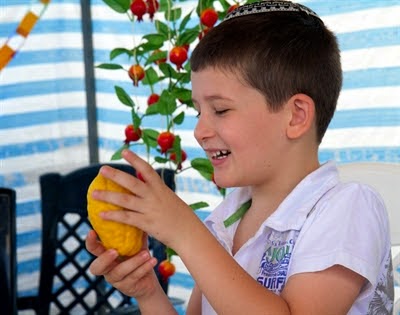
An Israeli boy in a Sukkah (temporary shelter for the Feast of Tabernacles)
examines a fragrant citron, one of the Four Species or Sukkot (see
Leviticus 23:40).


Keynote speaker Robert Stearns, founder and executive director of Eagles' Wings ministry, spoke of the historical division between Jews and Christians and the need to unite. "Horrible things were done to Jews in the name of Christianity, but that was never the spirit of the true followers of Jesus,” he said.  "Jesus was not a Christian.  He was a Jew, and we follow the Jewish Jesus.  We received the Bible and the Prophets from the Jewish people." Meanwhile, several noteworthy Jewish and Christian leaders, including Lauder, introduced a joint letter urging world leaders to bring an end to the persecution of the Middle East's Christians. “We as Jews know how important it is to speak out.  In the 1930s in Germany when Jews were deprived of their rights and persecuted, the world was silent. We know what happens when the world is silent, so today we are standing up and speaking out,” Lauder said. "Just as Christians defend Jews against anti-Semitism, just as Christians support Israel, we Jews have an obligation to speak out against the growing persecution of Christians in many parts of the world," Lauder said.  “When hundreds of thousands of Christians—men, women and children—are killed, this isn’t war.  This is genocide.  And we Jews know what happens when the world is silent to genocide."  "Islamist extremists have launched a full-fledged assault on our Western values, on our civilization, and Jews and Christians must work hand in hand to defeat this threat," he said.  "Together, we must speak as one and tell the world: no more discrimination, no more terror, no more death, and no more silence!”
Ronald S. Lauder, president of the World Jewish Congress


Lauder's signature joined those of ICEJ executive director Dr. Jürgen Bühler and of Dr. William Wilson, co-chairman of the Empowered21 Global Council, an Oklahoma-based organization that seeks "a fresh outpouring of the Holy Spirit in the 21st century." "To have a prominent global Jewish leader lend his voice to this moral call for protecting the region’s persecuted Christians is unprecedented in modern times," Bühler said.  "We welcome all others of goodwill who will take a stand now for these vulnerable ancient Christian communities."  The "Vicar of Baghdad," Reverend Canon Andrew White, also responded gratefully to Lauder's presence at the event, noting that the Church also needs to stand with Iraq’s beleaguered Christians. "Here we see Jews standing with us, but where is the Church?" he asked, noting that Christians who are fleeing the Islamic State urgently need of food and water. “I was hungry and you gave Me something to eat, I was thirsty and you gave Me something to drink, I was a stranger and you invited Me in, I needed clothes and you clothed Me, I was sick and you looked after Me, I was in prison and you came to visit Me. ...  Truly I tell you, whatever you did for one of the least of these brothers and sisters of mine, you did for Me.”  (Matthew 25:35–40)

Wednesday, 5 November 2014


Israel Takes a Stand Against Persecution of Middle East Christians-3

$2.2 Million Grant Funds Hebraic Heritage Course for Jews and Christians

"Again I asked him, 'What are these two olive branches beside the two gold pipes that pour out golden oil?'  He replied, 'Do you not know what these are?'  'No, my lord,' I said.  So he said, 'These are the two who are anointed to serve the Lord of all the earth.'"  (Zechariah 4:12–14
The United States-based Templeton Foundation (JTF) has awarded Machon Herzl (the Herzl Institute of Jerusalem) a $2.2 million grant for helping Jews and Christians study Jewish texts together. It is being hailed as the first ever multimillion-dollar push toward bolstering Jewish theology. Yoram Hazony, president of the Herzl Institute, praised the move, saying in a press release, "We're not just talking about Christians wanting to help Jews out of solidarity or charity, we are talking about the dominant faith of Western civilization [that is] saying: 'The Jews have something to give us, something that we need.'" "This is not something that appears in the old playbook for Jewish-Christian dialogue," he emphasized.

Yorom Hazony, President of Herzl Institute
  
As well, next year in Jerusalem, in a program co-sponsored by the Jerusalem-based Herzl Institute and the King's College in Manhattan, Christian students will be able to attend a semester program called "Biblical Philosophy and Hebraic Heritage,” a course in which they will study and learn from Orthodox Jewish teachers for a summer. The goal of the program is to unlock theological understanding from fresh, alternative perspectives. "This is completely new dialogue, where we look at Old Testament text and rabbinic texts, and Christians are willing to look at Judaism and the Jewish text through Jewish eyes with Jewish lecturers," Hazony stated. Hazony identified a "new sense that there are many Christians who want to hear what Jews have to say," which "fits very well with a dormant Jewish feeling that we have a mission to say something, but for a long time people weren’t interested in hearing what we have to say."  The program, to take place June through August 2015, will include such picks as "The Philosophy and Political Theory of the Hebrew Bible;" "The Impact of the Hebraic Heritage in Western History;" and "Jews, Judaism, and Zionism in the Middle Eastern Context."  "This is what the Lord Almighty says:  'In those days ten people from all languages and nations will take firm hold of one Jew by the hem of his robe and say, "Let us go with you, because we have heard that God is with you."'"  (Zechariah 8:23)

UN Secretary-General Ban Ki-moon inside a Hamas terrorist tunnel near
Kibbutz Ein Hashlosha in Israel.


Ban Ki-Moon Blames Israel for Gaza War as PA Snares $5.4 Billion

“For three sins of Gaza, even for four, I will not relent.  Because she took captive whole communities and sold them to Edom, I will send fire on the walls of Gaza that will consume her fortresses.”  (Amos 1:6-7)

During a visit to Israel and Gaza, United Nations Secretary General Ban Ki-moon walked through a Hamas terror tunnel last Tuesday, after a donor conference in Cairo on Sunday where he claimed that Israel’s “occupation” was responsible for the Gaza war. “We must not lose sight of the root causes of the recent hostilities: A restrictive occupation that has lasted almost half a century, the continued denial of Palestinian rights and the lack of tangible progress in peace negotiations,” Ban said at the Cairo conference, which drew $5.4 billion in pledges for Gaza’s reconstruction. While Ban’s remarks at the Cairo conference drew anger from several sides, including the Anti-Defamation League and Israeli Prime Minister Benjamin Netanyahu, the secretary general’s response two days later to the terror tunnels implied surprise at the reach of Hamas: “I was shocked by the tunnels used for the infiltration of terrorists.  No one needs to live under the constant threat and fear of rockets and tunnels digging underground,” Ban said, after Israeli soldiers led him through the sites of the war’s greatest impact.

Secretary-General Ban Ki-moon (left) meets the Tragermans at Kibbutz
Nirim in Israel.


Ban also visited with Daniel Tragerman’s relatives, including his mother, Gila, who had implored Ban in a letter to accuse Hamas of “war crimes” for the more than 3,600 rockets Hamas launched into Israeli civilian areas, wreaking havoc and killing several, including 4-year-old Daniel.  Gila’s letter came after Ban accused Israel of “war crimes” on the day of Daniel’s murder. “I just met the grandparents and uncle of Daniel, four years old, just a young boy.  What has he done wrong?  Why has he to die?  Even without knowing anything, even without being able to grow up. “I conveyed my deepest condolences to the family, but I only hope that my words of condolence will help a little bit to heal their wounds, but that may not be enough.  For that, I am urging again that the two parties address all the underlying issues, to bring peace and harmony and security to the two peoples,” Ban said following his meeting with the family.

Israel’s Prime Minister Benjamin Netanyahu meets with UN Secretary
General Ban Ki-moon.


A day after Ban’s errant remarks in Cairo, Netanyahu publicly stated before meeting with Ban that Israel’s complete withdrawal from Gaza in 2005 completely invalidated the idea of an “occupation” in Gaza.  “The root cause of the violence that burst from Gaza is not Israel’s occupation in Gaza, for a simple reason: Israel doesn’t occupy Gaza,” Netanyahu said.  “Israel left Gaza to the very last centimeter, to the very last inch.  We uprooted all the settlements and vacated all the settlers.  So there is no Israeli occupation of Gaza.”  “The root cause of Hamas’ rocket fire on Israel is Hamas’ opposition to Israel’s very existence,” he said.

Secretary-General Ban Ki-moon (left) meets with Mahmoud Abbas,
President of the State of Palestine, in Cairo, Egypt.


Israeli Knesset (Parliament) Speaker Yuli Edelstein spoke to Israel Radio about similar statements at the conference to “end the ‘occupation’" that were issued by Palestinian Authority head Mahmoud Abbas. “What he calls ‘ending the occupation’ already happened in the Gaza Strip in August 2005,” Edelstein said. Edelstein also criticized Cairo for not inviting Israel to the Gaza-reconstruction conference and said Gaza’s ability to rebuild its civilian infrastructure will require more than Sunday’s successful fundraising. The donations, including a $1 billion pledge from Hamas-funder Qatar, lack proper supervision, which might lead to the incoming wealth falling straight into the hands of Hamas terrorists, Edelstein said.  “The damage coming from a lack of supervision is double: Nothing will reach the population and Hamas’s temptation to start a new round of violence once it strengthens itself will be great, so all of the money invested in rehabilitation will go down the drain,” he said.

Secretary-General Ban Ki-moon (second from left) meets with internally
displaced persons (IDPs) during his visit to the Gaza Strip.


Meanwhile, Israel has shifted significantly in permitting  the movement of people and produce in and out of Gaza this week, allowing Gazan farmers and fishermen to transport their goods to the West Bank market for the first time since 2007, when Hamas violently took over the Gaza Strip. Israel also continues to donate humanitarian aid to Gaza, and this Tuesday alone sent in 3,000 tons of construction materials to rebuild Gaza’s civilian infrastructure. The 2,000 tons of gravel, 600 tons of cement and 400 tons of steel will be monitored by a supervisory team of Israeli, PA, and UN representatives, in order to keep the materials from being used to build terror infrastructure.
Israeli President Reuven Rivlin opened his sukkah to the public during
the week-long holiday of Sukkot.  In the photo above, Secretary-General of
the United Nations Ban Ki-moon signs the guest book.

Thursday, 30 October 2014


Israel Takes a Stand Against Persecution of Middle East Christians-2

"Jerusalem will be trampled on by the Gentiles until the times of the Gentiles are fulfilled."  (Luke 21:24)


British House Majority Tries to Trump Peace Talks

"O God, the nations have invaded your inheritance; they have defiled your holy temple, they have reduced Jerusalem to rubble. … We are objects of contempt to our neighbors, of scorn and derision to those around us."  (Psalm 79:1, 4)

The United Kingdom's House of Commons voted in favor of recognizing Palestine as a state alongside Israel.

The House of Commons 

In a vote that gave Hamas a virtual pass, 274 parliamentarians voted in support of a nonbinding motion to compel the government "to recognize the State of Palestine as a contribution to securing a negotiated two-state solution."  Twelve voted against the motion. Instead of advancing peace, however, the motion hinders it. “Premature international recognition sends a troubling message to the Palestinian leadership that they can evade the tough choices that both sides have to make, andactually undermines the chances to reach a real peace,” Israel's Foreign Minister stated in response.

Palestinian Authority Foreign Minister Riyad al-Malki

Palestinians, however, welcomed the vote, and Palestinian Authority Foreign Minister Riyad al-Malki urged London to transform the vote into official UK policy, calling on London to "immediately recognize the state of Palestine."  (Arutz Sheva) Senior Palestine Liberation Official Hanan Ashrawi issued a statement that said the vote “will enhance the European voices calling for the recognition of the State of Palestine and will create the right environment for the international community to grant the Palestinian people legal parity and rights.” In an interview with Israel Radio, British Ambassador to Israel Matthew Gould said, “Although this vote won’t affect government policy, I think it is right to be concerned about what it signifies in terms of the direction of public opinion."

Former Sderot Mayor David Buskila (left) in 2011 shows British
Ambassador to Israel Matthew Gould (right) a pile of Qassam rockets
that Gaza fired into Sderot, Israel.


While the symbolic vote does not change Britain's foreign policy, it disregards the steps required for the conflict-resolution process between Israel and the Palestinian Authority (PA) to succeed. "The route to Palestinian statehood runs through the negotiation room," the Israeli Embassy in London said after the vote. In a response to the vote, the British chapter of StandWithUs, a non-profit pro-Israel education and advocacy organization, stated that the atmosphere of the debate was marked with a disturbing tone and provocative remarks. "With MPs from across the political spectrum accusing Israel of encouraging racial hatred—or speaking of an all-powerful ‘Jewish lobby,' there is definitely something wrong in the way our elected representatives perceive the conflict," StandWithUs states. Paul Hirschson, a spokesperson for Israel's foreign ministry, said the government of Israel already supports a Palestinian state, "so there’s no big deal here on substance; the question is process."  (Time)

French Foreign Minister Laurent Fabius

French Foreign Minister Laurent Fabius said recognition of a Palestinian state must not be symbolic. He told France's lower house National Assembly, “From the moment that we say there must be two states (Israel and Palestine), there will be a need for recognition of the Palestinian state, that goes without saying.” “The only question is what are the procedures and how to be most effective.  What we want is not a symbolic issue but to be helpful to peace,” he continued. British Prime Minister David Cameron also dismissed Monday's symbolic vote by refusing to take part in it.  At present, Cameron's government stands against recognition of a Palestinian state but would change its position at any time if it would assist the peace process, according to officials.

Israeli Prime Minister Benjamin Netanyahu welcomed British Prime
Minister David Cameron to Israel earlier this year.


The British House vote comes three days after Sweden's newly elected Prime Minister Stefan Löfven broke Swedish law by acting alone to recognize an independent Palestinian state without approval from the country's Advisory Council on Foreign Affairs. Swedish Parliament member Annicka Engblom called Löfven’s action out of turn: “Our practice in Swedish foreign policy is [that for a state to be recognized, it] has to fill certain criteria such as full control over territory and functioning of the government, such as in Kosovo before we recognized Kosovo,” Engblom explained.

A Gaza child draped in a Fatah flag poses with a weapon.

In contrast to calls to reach a solution through negotiation, PA legislator Hanan Ashrawi said that "the recognition of Palestine is not contingent on the outcome of negotiations with Israel and certainly not something we will trade for." The PA does not seek a mutual peace agreement with Israel because its charter does not recognize the right of Israel to exist. "Fatah's Charter declares unambiguously: 'Our struggle will not cease unless the Zionist state is demolished, and Palestine is completely liberated,'" reminds International Law Professor Louis René Beres of Purdue University.  "Even now, the official PA map identifies Israel as a mere part of Palestine.  The official logo of PA Television still shows all of Israel as Occupied Palestine, with only the Palestinian capital in Jerusalem," Beres added.

With the map of the entire land of Israel covered by weaponry, the
Fatah logo reveals the party's ultimate goal of conquering all of Israel.


"Fatah's official insignia remains: Israel smothered by a grenade, bayoneted rifle, and submachine gun.  All PA school textbooks use a map of the Middle East in which Israel does not even exist, and has been replaced in its entirety by a state called Palestine," Beres adds. This primary goal of Fatah and Hamas to eliminate Israel coupled with unilateral moves to create a Palestinian state opposes the 1993 Palestinian Liberation Organization (PLO) agreement during the Oslo Peace Accords to negotiate a solution through territorial compromise.  During those accords, the PLO officially recognized Israel, and Israel officially recognized the PLO as a negotiating partner in the remaining issues leading to statehood. But like all attempted peace plans, terrorism trumped diplomacy when the Second Intifada erupted in September 2000 against Israel. "I will encamp at My Temple to guard it against marauding forces.  Never again will an oppressor overrun My people, for now I am keeping watch."  (Zechariah 9:8)
 
Jerusalem