Tuesday, 14 October 2014


Sukkot begins, it's a Joyous Biblical Festival for both Jews and Christians-3

Arba Minim: The Four Species

“You shall take for yourselves on the first day [of the festival] the splendid fruit of a tree [etrog], palms of dates [lulav], the branch of the thickly leafed tree [hadas], and willows [aravot] of the brook.”  (Leviticus 23:40)Another observance carried out each day of Sukkot except Shabbat is the Four Species (Arbah Minim): an etrog (citron), a lulav (palm frond), three hadassim(myrtle twigs) and two aravot (willow twigs).  They are bound together in such a way that they can be held together easily. The lulav, hadassim and aravot are first taken up with the right hand and then the etrog is taken with the left hand.  A blessing is recited over the Four Species: “Blessed are You, God … who has sanctified us with His commandments and commanded us to take the lulav.” Facing east where the Temple in Jerusalem once stood, the Four Species are then shaken in all six directions:  right, left, forward, up, down and backward. Rabbinic tradition explains that the Four Species represent the various personalities that make up the community of Israel.  They are held together and a blessing is recited over them to bless the unity of all people, which is emphasized on Sukkot.


Israeli Prime Minister Benjamin Netanyahu holds
the lulav and the etrog (citron) of Sukkot.


The Season of Our Joy

“You shall rejoice before the Lord your God.”  (Leviticus 23:40) One of the names for Sukkot is Z'man Simchateinu (The Season of Our Joy).  In Scripture, in fact, the word joy appears several times in connection with Sukkot. “Be joyful at your Feast—you, your sons and daughters, your menservants and maidservants, and the Levites, the aliens, the fatherless and the widows who live in your towns.… For the Lord your God will bless you in all your harvest and in all the work of your hands, and your joy will be complete.”  (Deuteronomy 16:13–15) Since Sukkot is also a harvest festival, we can well imagine that there is great reason for joy.  Indeed, one of the other names for the holiday is the Feast of Ingathering.

“Celebrate the Feast of Ingathering at the end of the year, when you gather in your crops from the field.”  (Exodus 23:16)


Many evangelical Christians show their love of the Jewish People by taking part in the annual Sukkot parade in Jerusalem.

The joy of this holiday is so singular and complete that many rabbinic texts just refer to it as HaChag (The Festival). During ancient times, every day of The Festival, except Shabbat, was characterized bymusic, song and dancing. Even today, Jewish people gather near the Western (Wailing) Wall to dance, sing and rejoice before the Lord.  People fill the synagogues and streets while singing and dancing with tremendous joy until the wee hours of the morning. This is in partial fulfillment of prophecy.  The Prophets tell us that a day will come when the exiles of Israel return to Zion.  Her streets will be filled with the sounds of joyful melodies, and sorrow will disappear. “The ransomed of the Lord will return.  They will enter Zion with singing; everlasting joy will crown their heads.  Gladness and joy will overtake them, and sorrow and sighing will flee away.”  (Isaiah 51:11)


A young man in front of a Torah Ark at the Western
(Wailing) Wall with the Four Species.

The Water Libation Ceremony

“With joy you shall draw water out of the wells of salvation.”  (Isaiah 12:3)

In Temple times, a special Water Libation (offering) ceremony took place daily during Sukkot.
Every day, the priests, along with a procession, would go down to the Pool of Shiloach (Siloam), which was fed by the Gihon Spring, the original source of Jerusalem’s water.  At the pool of natural running water, they would fill a golden flask. The water was then brought back to the altar in the Temple to accompany the morning sacrifice.  This pouring of the water on the altar is called Nishuch haMayim (Water Libation Ceremony / literally, Pouring of the Water). This water offering not only celebrates the hope of winter rains in Israel, but also symbolizes the future Messianic Redemption when the Spirit of God (symbolized by the water) is poured out upon the nation of Israel.


Because it doesn't rain in Israel during the summer, this Israeli is
delighting in the first rainfall of autumn.

Friday, 10 October 2014


Sukkot begins in a few hours - it's a Joyous Biblical Festival for both Jews and Christians-2 

Blood Moon of Sukkot
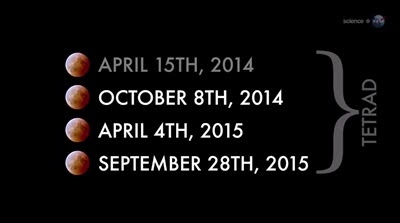
"There will be signs in the sun, moon and stars.  On the earth, nations will be in anguish and perplexity at the roaring and tossing of the sea."  (Luke 21:25) This year, Sukkot essentially begins with the second Blood Moon (full lunar eclipse) of the Blood Moon Tetrad, which is four second of four consecutive lunar eclipses that coincide with Passover and Sukkot in 2014 and 2015. “Not since 1967—and only four times in the past five hundred years—has a Tetrad of total solar eclipses corresponded to the Jewish Feasts, which historically has signaled the beginning of dramatic events that change the course of world history.  This series of blood moons is no different,” said Pastor John Hagee, author of the New York Times bestseller Four Blood Moons. “God has absolute control of the sun, moon, and stars.  He has used them in the past to send signals to humanity that something big was about to happen,” Hagee said.  “The heavens are still God’s billboard that sends signals to us today—but are we watching for them?”
This Science at NASA graphic reveals the sequence of the tetrad, four
lunar eclipses occuring in six-month intervals with no partial lunar
eclipses in between.  The next will happen on Passover (April 4, 2015)
and the last on Sukkot (September 28, 2015).  


Indeed, the first Blood Moon on April 15, hailed significant events in Israel.

Shortly after it, the rival Palestinian groups of Fatah and Hamas formed a unity government.  Just after that, three Jewish teens were abducted and murdered.  Next Hamas unrelentingly bombed Israel, causing war to break out between Israel and the Gaza Strip.  As war raged, anti-Semitism and anti-Israelism grew around the world.Also since that first Blood Moon, the terrorist group ISIS grew in strength and numbers.  The world has seemed to stand helpless as resistance across Iraq was crushed with extreme violence, as people who refused to convert to ISIS' brand of Islam were killed or driven from their homes, and as people were brutally beheaded. It is quite possible that today's second Blood Moon comes before more events that signal we are in the Last Days, especially pertaining to prophetic events unfolding in Israel. "The sun will be turned to darkness and the moon to blood before the coming of the great and dreadful day of the LORD."  (Joel 2:31)

During a full lunar eclipse, the moon turns red as it reflects the glow from
the earth of all of the earth's simultaneous sunrises and sunsets.  (NASA)


Sukkot: Remembering God's Faithfulness

The first day of Sukkot is a Sabbath and most forms of work are prohibited. The other days of the holiday are called Chol HaMoed (weekdays of the festival or intermediate period).  During these days the workload is reduced; and here in Israel, many people take the week off as vacation. After the somber, introspective time of Yom Teruah (Rosh HaShanah / Jewish New Year) and Yom Kippur (Day of Atonement), Sukkot is a joyous celebration of renewed relationship with God following atonement for sin. During this festive season, we recall how God’s faithfulness provided for our ancestors as they wandered the Sinai Desert wilderness for 40 years before entering the Promised Land of Israel. “You shall dwell in Sukkot for seven days ... that your future generations shall know that I had the children of Israel live in Sukkot when I brought them out of Egypt.” (Leviticus 23:42–43)
Jewish children learn to recite the blessings over the Arba Minim (Four
Species) on Sukkot at the Western (Wailing) Wall in Jerusalem.


At Sukkot we remember God’s kindness and mercy in leading and guiding Israel by day with a pillar of cloud and protecting them by night with a pillar of fire, and for providing them with daily manna. Just as Israel dwelt in temporary shelters called sukkot (sukkah is singular), so are we to dwell in sukkot for this entire week. Most people in Israel and Jewish people around the world build a temporary hut or shelter with a covering of branches or palm leaves. For seven days and nights, we eat in the sukkah and consider it our dwelling; some live in the sukkah entirely for the duration of the festival, even sleeping in it through all kinds of weather.

Sukkot in Israel are often built on verandas and balconies.


Thursday, 9 October 2014


Sukkot begins in a few hours - it's a Joyous Biblical Festival for both Jews and Christians-1 


Jewish men hold the Arba Minim (Four Species) in their hands as they
pray on Sukkot at the Western (Wailing) Wall in the Old City of Jerusalem.


"On the first day you are to take branches from luxuriant trees—from palms, willows and other leafy trees—and rejoice before the LORD your God for seven days." (Leviticus 23:40)

Chag Sameach!  Happy Sukkot!

“In sukkot you shall dwell for seven days: all 
citizens of Israel shall dwell in sukkot.”(Leviticus 23:42)


Yestarday at sunset begins the Biblical Holiday of Sukkot (Feast of Tabernacles / Booths), which completes the cycle of the Fall Feasts. This wonderful Biblical holiday lasts for a full seven days! It is one of three pilgrimage festivals called Shelosh Regalim (Three Pilgrimages), holidays during which the Jewish People were required to go up together as a nation to the Holy Temple in Jerusalem. The other two of the Shelosh Regalim are Pesach (Passover) and Shavuot (Feast of Weeks) (Deuteronomy 16; Exodus 23:14–17).

Sukkot (Tabernacles) is one of the three major holidays for which the
Jewish populace traveled to the Temple in Jerusalem and lived for a
week in booths (temporary shelters).  Today, Jews still travel to Jerusalem
to keep this holiday.

One of the names of Sukkot is the Festival of the Nations.  And today we certainly see signs of the nations embracing this holiday.  People from all over the world gather in Jerusalem for it. According to the prophet Zechariah, this holiday also has a prophetic dimension that is yet to be fulfilled. When Messiah returns and establishes His Kingdom, all the nations will be required to keep this holiday by coming up to Jerusalem to celebrate Sukkot. (Zechariah 14:16–17) In that day, Messiah Yeshua (Jesus) will become Israel’s sukkah (tabernacle).  His presence will shelter Israel and she will no longer be oppressed by the nations.

Praying on Sukkot at the Western (Wailing) Wall in Jerusalem with the
Four Species: citron, palm, myrtle, and willow.

Monday, 15 September 2014

Despite ceasefire, Hamas claims Jerusalem is ultimate goal-1 


Kerry, ISIS Perilously Close to Israel

“Do not keep silent, O God!  Do not hold Your peace, and do not be still, O God!  For behold, Your enemies make a tumult; and those who hate You have lifted up their heads....  The tents of Edom and the Ishmaelites; Moab and the Hagrites; Gebal, Ammon, and Amalek; Philistia with the inhabitants of Tyre; Assyria also has joined with them; they have helped the children of Lot.”  (Psalm 83:1-2, 6–8) After the abduction of United Nations' forces in Syria by rebel forces, the Syrian army and rebel Islamic forces continue to battle along Israel’s Golan border with Syria, placing the Israel Defense Forces (IDF) on high alert in the Golan Heights. The IDF also ordered farmers and civilians to vacate the Syria border area amid fierce fighting at the Quneitra crossing. The shelling has been so intense that a Bibles For Israel worker who lives in Tiberias on the Sea of Galilee (Lake Tiberias) said that it could be heard all the way from the Golan Heights.


The worsening of the security situation on the Golan has included the abduction of 43 Fijian UN peacekeepers by al-Qaeda-affiliate al-Nusra Front at the Quneitra crossing with Israel, the surrounding of 72 UN peacekeepers from the Philippines, and a Syrian drone in Israeli airspace on Sunday, 31st August. On Wednesday, mortar shells pounded the Golan Heights.  The shells and stray bullet fire injured an Israeli officer and a civilian. Israel shot down the drone and returned fire, holding Syria responsible for all such occurrences. “We see the Syrian Army as responsible for all fire into Israel,” an army spokesman said. The fire, however, is more likely coming from rebel forces that have taken the border crossing at the town of Quneitra, which Islamic forces had vowed to “liberate.”United States Secretary of State John Kerry called on the world to unite to defeat ISIS terror, which has recently included such gruesome depravities as the capture and execution of 160 Syrian soldiers. “They have already demonstrated the ability to seize and hold more territory than any other terrorist organization, in a strategic region that borders Jordan, Lebanon and Turkey and is perilously close to Israel,” he wrote in a New York Times piece published Friday [29th August].


US Secretary of State John Kerry and Israeli Prime Minister Benjamin
Netanyahu look out over Jerusalem.

On Saturday,30th August, al Qaeda-linked Syrian rebels of the Nusra Front attacked UN peacekeepers in the Golan Heights while other UN troops were able to flee from a different encampment also surrounded by rebels. The Philippines’ Defense Secretary Voltaire Gazmin said that over 70 Filipino peacekeepers had escaped from two areas in the Golan Heights that came under attack by Syrian rebels on Saturday after moving to a safer area. This followed a seven-hour siege in which fire was exchanged with the rebels.  (WSJ) A spokesman for UN General Secretary Ban Ki-Moon said last week in New York that the organization was working to free the captives through negotiations with parties inside Syria and governments linked to Syrian rebel groups.  (NYT) The United Nations troops are part of the United Nations Disengagement Observer Force that was put in place to police a demilitarized zone between the Israeli-held Golan Heights and Syria following the ceasefire and military disengagement agreement between Israel and Syria signed in 1974.Personnel include troops from India, Ireland, Nepal and the Netherlands.


An IDF soldier stands guard at a military base in the Golan Heights.


The spillover from Syria comes at a time that the Israeli public is still suffering from Gaza bombing. Writing for the website “American Thinker,” Carol Brown points out that the Israeli public is unhappy with the outcome of the Gaza conflict and that Netanyahu’s approval rating has fallen to 32%, with most (59%) saying that Operation Protective Edge was a failure. Equating Hamas with ISIS she says, “We cannot afford to take our eyes off of Israel.  She is on the bleeding edge of the fight against Islamic jihad.” Brown describes Israel as the first wave of troops in the fight against the Jihadists, stating, “The advance against Israel is an ultimate advance against the United States.  She is like the first wave of troops that get sent into battle.  If she goes down, we’re up next.”